


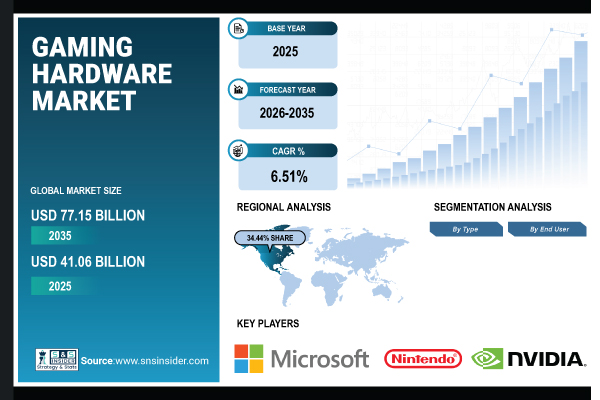
The global gaming hardware market is on track to reach $77.15 billion by 2035, nearly doubling from its current valuation of $41.06 billion in 2025, according to a report published by SNS Insider on February 3, 2026. The market is expected to grow at a compound annual growth rate of 6.51% over the next decade.
The projection reflects the gaming industry’s continued expansion beyond its traditional niche audience into mainstream entertainment. With an estimated 3.1 billion players worldwide, gaming has evolved into a global phenomenon generating revenues that exceeded the combined earnings of movies, music, and books in 2021.
Key Growth Drivers
Live streaming of multiplayer gaming events has emerged as a significant market driver, expanding the visibility and appeal of gaming hardware to broader audiences. The rise of esports, combined with advancements in machine learning and artificial intelligence, continues to push hardware innovation forward.
AI-driven technologies are improving everything from player matchmaking systems to network efficiency, creating demand for more powerful and sophisticated gaming equipment. These technological improvements directly influence consumer purchasing decisions as players seek hardware capable of delivering competitive advantages and enhanced experiences.
Regional Market Performance
The United States gaming hardware market was valued at $11.04 billion in 2025 and is projected to reach $20.73 billion by 2035. This growth stems from rising demand for high-performance PCs and accessories, expanding esports infrastructure, and adoption of advanced technologies including VR and AR headsets, high-refresh-rate displays, and next-generation GPUs.
The market expansion isn’t limited to North America. Nearly half of the world’s population now plays video games in some capacity, creating demand for gaming hardware across all global regions.
Hardware Categories and Technologies
The report highlights several hardware segments contributing to market growth. High-performance GPUs remain critical components as games demand increasingly sophisticated graphics capabilities. Gaming peripherals including mechanical keyboards, precision mice, and specialized headsets continue to see strong consumer adoption.
Virtual reality and augmented reality hardware represent emerging categories with significant growth potential. As these technologies become more accessible and affordable, they’re expected to drive additional hardware sales throughout the forecast period.
Industry Implications
The projected growth to $77.15 billion by 2035 signals continued investment opportunities across the gaming hardware ecosystem. Manufacturers face pressure to innovate while managing component costs and supply chain challenges.
The steady growth rate of 6.51% annually suggests a maturing but still expanding market. Unlike the explosive growth phases seen in earlier decades, this projection indicates sustained, stable demand driven by technological advancement rather than market penetration alone.
For consumers, the market expansion likely means continued hardware innovation, improved price-to-performance ratios over time, and greater accessibility to advanced gaming technologies that currently remain premium products.